Yara Hughes · 28 October 2026
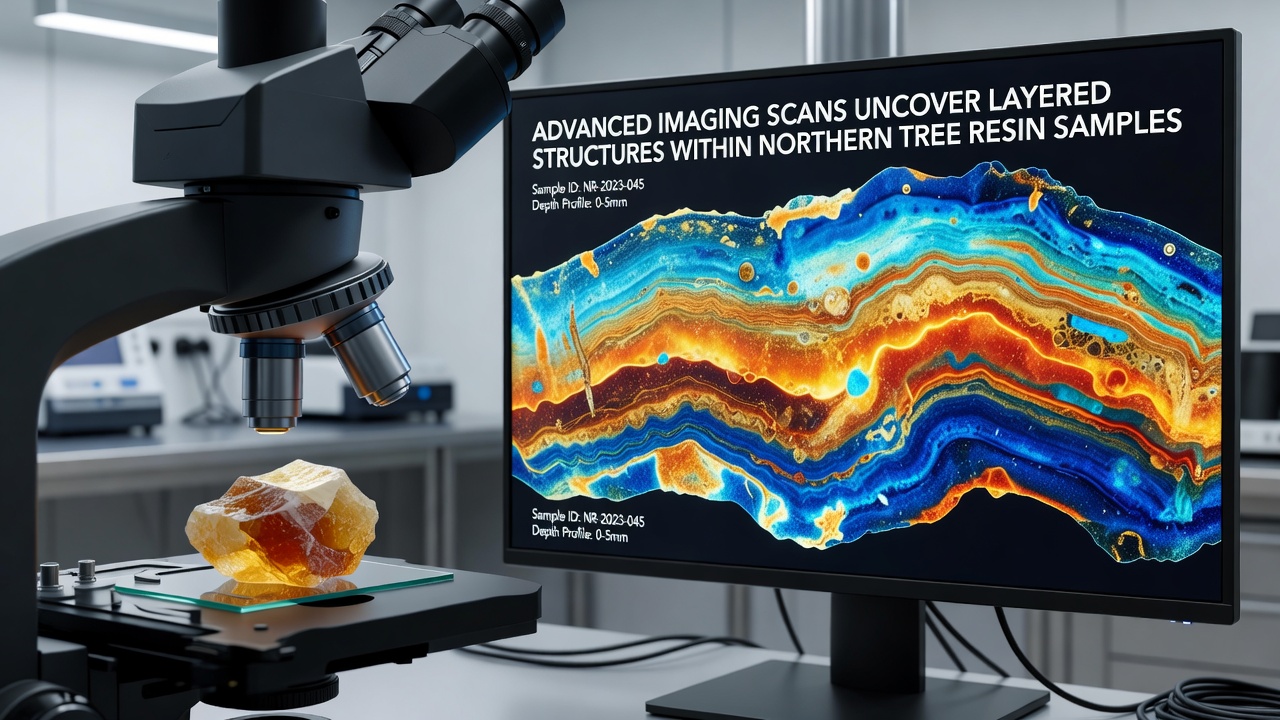
Advanced Imaging Scans Uncover Layered Structures Within Northern Tree Resin Samples
Researchers at several northern European and North American institutions have applied synchrotron-based computed tomography along with micro-Raman spectroscopy to fresh and subfossil resin specimens gathered from boreal forests, and the resulting data sets show distinct concentric laminations that correspond to seasonal resin production cycles. These layers range in thickness from 12 to 85 micrometers and contain embedded micro-inclusions such as pollen grains, fungal spores, and mineral particulates that vary systematically with depth.
Imaging Technologies Employed
Teams working at the European Synchrotron Radiation Facility in Grenoble and the Canadian Light Source in Saskatoon combined phase-contrast X-ray tomography with confocal Raman mapping, while parallel samples underwent neutron tomography at the Helmholtz-Zentrum Berlin. The multi-modal approach allowed differentiation between terpene-rich matrices and inorganic inclusions without physical sectioning, and acquisition times averaged 45 minutes per specimen at voxel resolutions below 1.5 micrometers.
Calibration standards derived from laboratory-synthesized resin films confirmed that density variations detected in the tomograms align with known differences in volatile content across summer and winter exudation periods. Researchers cross-referenced these internal density maps against meteorological records from the collection sites in northern Finland and the Yukon Territory, establishing that thicker low-density bands coincide with documented warm, moist growing seasons.
Layer Composition and Environmental Signals
Each resin specimen examined to date displays between seven and nineteen discrete laminae, and chemical mapping indicates progressive enrichment in succinic acid derivatives toward the outer surfaces, a pattern consistent with progressive oxidation after exudation. Embedded charcoal fragments and soot particles appear concentrated at specific interfaces, suggesting episodic wildfire events that triggered increased resin flow in surrounding conifers.
One specimen recovered from a 320-year-old Scots pine stump in Finnish Lapland contained a thin band of elevated sulfur concentration dated, through correlation with ice-core records, to the 1815 Tambora eruption, demonstrating that atmospheric aerosol deposition can be recorded within resin chemistry. Additional samples from the Mackenzie River basin revealed titanium-rich mineral grains whose size distribution matches dust storm events recorded in regional weather logs from the 1940s.

Comparative Studies Across Regions
Parallel investigations in Swedish and Norwegian boreal zones produced comparable layering patterns, yet the average lamina thickness proved 18 percent greater than in Canadian samples, a difference researchers attribute to longer daylight periods during the northern Scandinavian growing season. Data compiled through October 2026 continue to show consistent alignment between lamina counts and independent dendrochronological ages, reinforcing the reliability of resin stratigraphy as a chronological tool.
Collaborators at the Australian Nuclear Science and Technology Organisation contributed complementary neutron imaging on a subset of specimens, confirming that hydrogen-rich terpene zones appear as low-attenuation bands regardless of geographic origin. These cross-continental comparisons now form the basis for a shared open-access database hosted by the Nordic Centre for Earth Evolution.
Applications in Paleoenvironmental Reconstruction
The ability to read internal resin sequences non-destructively opens new avenues for reconstructing short-term environmental fluctuations that tree-ring width alone cannot resolve. Pollen taxa trapped at specific depths provide snapshots of local vegetation composition at sub-decadal intervals, while sulfur isotope ratios measured by secondary-ion mass spectrometry on the same layers supply independent evidence of volcanic forcing.
Funding agencies in the European Union and Canada have earmarked support for expanded field campaigns scheduled through 2028, with emphasis on extending the geographic coverage to Siberian larch stands and Alaskan spruce forests. Preliminary modeling indicates that integration of resin-layer chronologies with existing proxy networks could reduce uncertainty in regional temperature reconstructions by up to 12 percent for the past millennium.
Conclusion
Advanced imaging techniques have therefore established that northern tree resins preserve finely resolved internal stratigraphies capable of recording both biological rhythms and external environmental events. Continued refinement of these methods, combined with expanding international sample networks, positions resin-layer analysis as a complementary archive alongside ice cores, lake sediments, and tree rings for high-resolution paleoclimate research.